Seoul Searching and Seoul Plates Diaries: Part Two
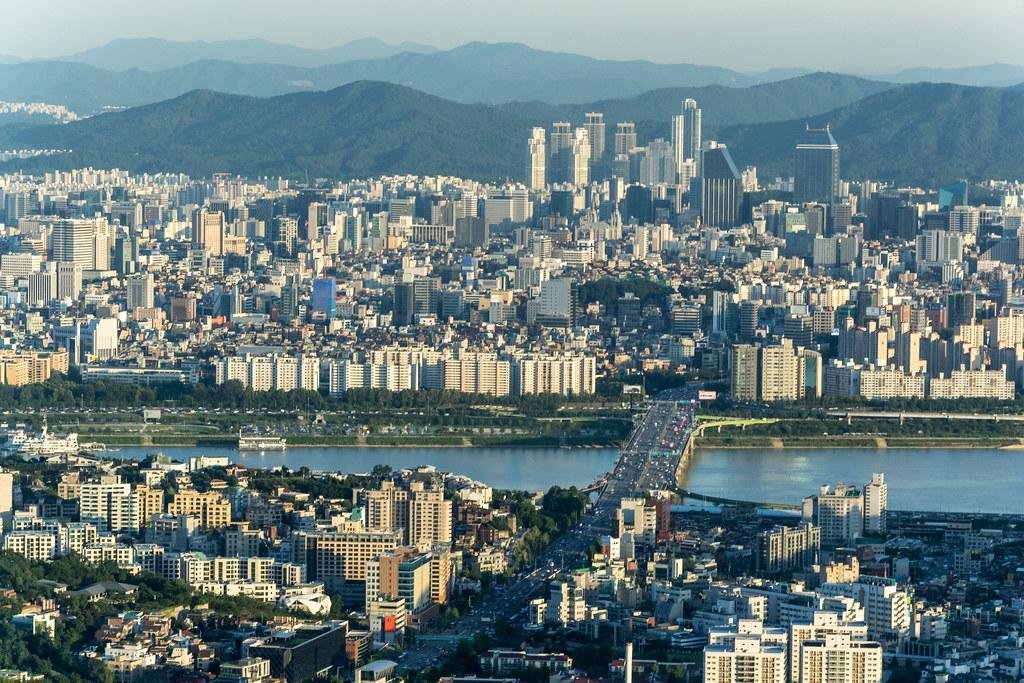
As I mentioned in my last post, the Gangnam area is relatively new, and we were there for a specific purpose. However, most of the time, our group gravitated to the century-old heart of Seoul, Gwanghwamun, and the Jongno-gu area.

Crossing the Han River

These areas are located north of Gangnam, across the Han River in the middle of the city, centered on the five royal palaces: Gyeongbokgung, Changdeokgung, Changgyeonggung, Deoksugung, and Gyeongbokgung. They are relatively close to one another, but I would recommend using Seoul’s excellent public transportation, taking a taxi, or hiring a guide. Namdaemun Market, Gyeongdong Market, cafes, galleries, and boutiques are located between the palaces and are must-sees.
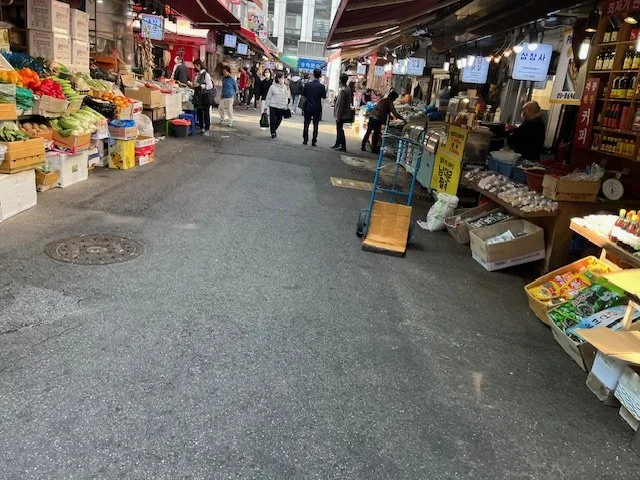
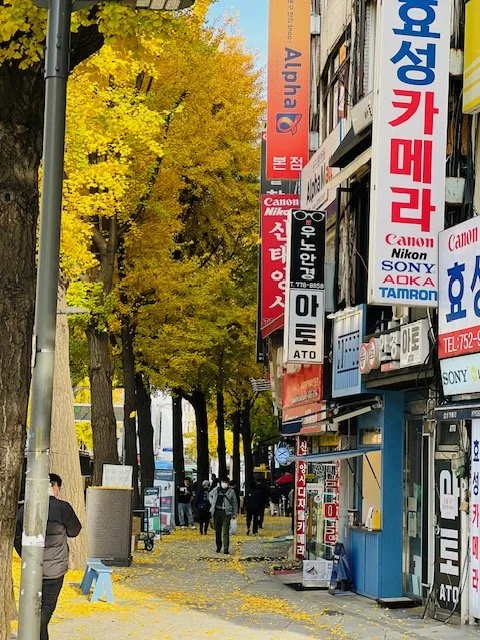
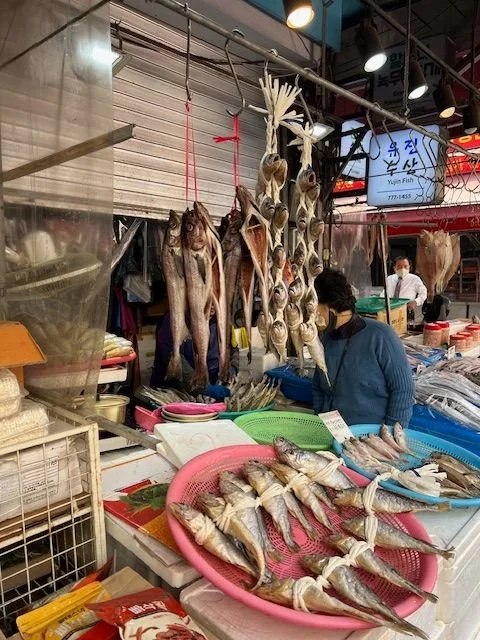
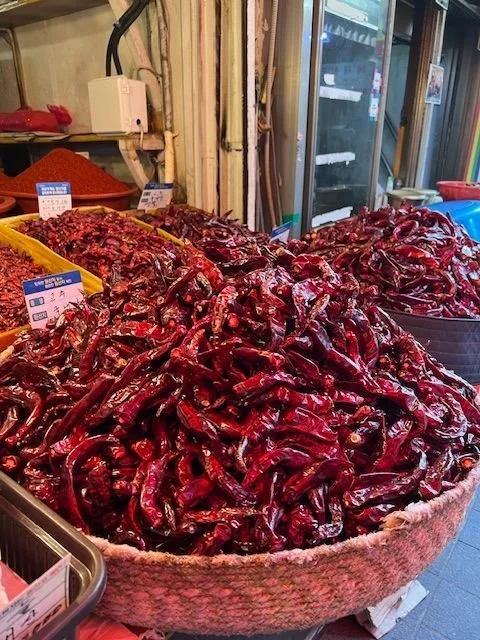
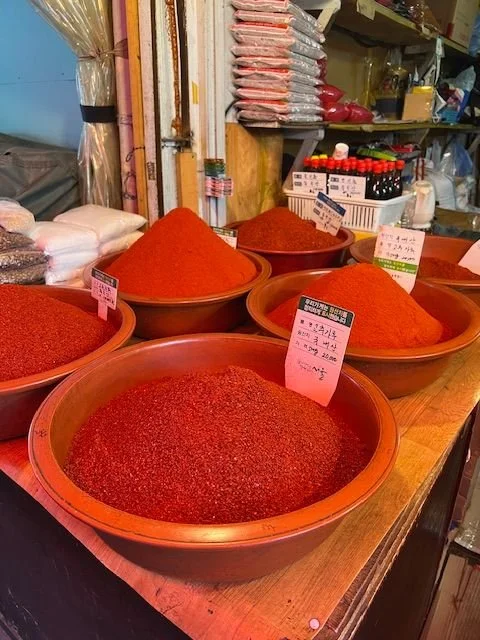
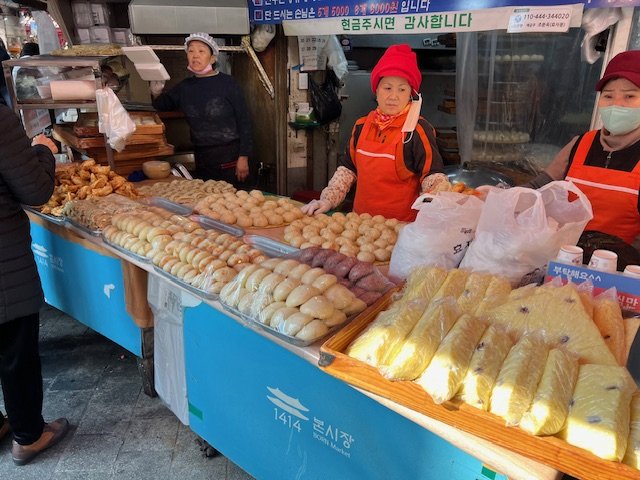
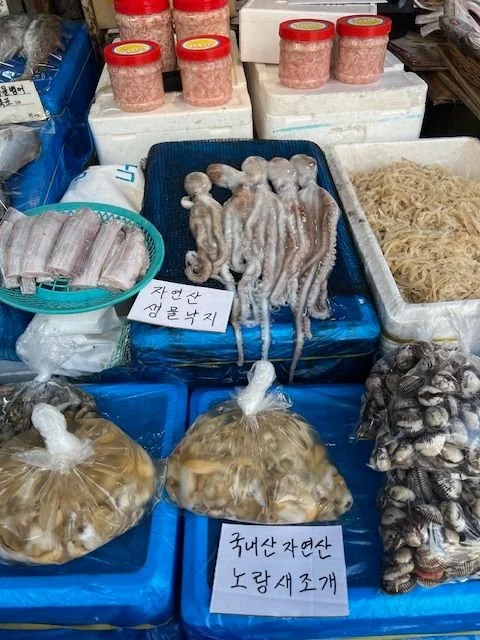
The Gyeondong Market is the largest herbal medicine and ginseng market in South Korea.
After our market experience, we asked the lovely ladies at the information booth where to have lunch. They guided us to a BBQ restaurant serving galbi, which means ribs in Korean.
It took us a while to find the restaurant. We didn’t realize at the time that many restaurants were on the second floor, with only small Korean signs directing the way up narrow staircases. It was worth the search; the food was delicious.
In Hawaii, galbi is called kalbi, and it is very popular. Many Korean and local restaurants served it. We were surprised to learn that Galbi—where the short ribs are sliced across the bone, making it easy to marinate in the delicious sauce—is called “LA galbi” in Korea. They also serve the thick short ribs in soups or stews. We were served Galbi-jim and LA galbi. They were both braised in a similar marinade, a sweet-and-savory sauce.
Kalbi or Galbi???
My husband, Tom, grew up in Hawaii. Korean BBQ ribs were called Kalbi. Before we left for our Korean trip, we were told that the Koreans call it Galbi. I decided to find out why. Simple answer: In 1903, the first Koreans came to work on the sugar plantations. The phonetic influence and blending of languages during the plantation era was the reason. The G in Galbi is pronounced as a soft K in Korean. So, that's why it is called Kalbi in Hawaii.
Recipe for Kalbi, Hawaiian style
This recipe is very easy and delicious. Everything is to taste.
You can use the meaty barrel-shaped short rib or the LA style. The BBQ restaurant we chose served LA-style BBQ. (See photo below.) If you use the meaty style, you must cut slits into the meat to ensure the marinade is absorbed. You will need soy sauce, sugar, garlic, green onions, and sesame oil and seeds. My mother-in-law, Marie, taught me that the difference between teriyaki and Korean sauce was the use of ginger and sesame oil. Teriyaki, you add fresh ginger along with garlic, but no sesame oil. However, in the kalbi sauce, you do not add ginger but add sesame seed oil. However, not everyone agrees. Some add ginger.
Ingredients:
2lb ribs
⅓ cup soy sauce
⅓ sugar ( you can add less, but you do not want your sauce salty, but to the sweeter side.)
4 or 5 garlic cloves, minced
2 Tb sesame seed oil
1 Tb sesame seeds
3 green onions, tops and bottoms chopped in ¼ inch pieces
Instructions:
In a bowl, add all the ingredients except the meat.
Mix well until the sugar dissolves.
Place the meat in a ziplock bag or bowl. Pour the liquid over the meat and soak for 24 hours if possible. It can be shorter, but the flavor will not be as rich.
Place on a charcoal or gas grill and cook to the desired doneness. I like a hot fire to char the edges.
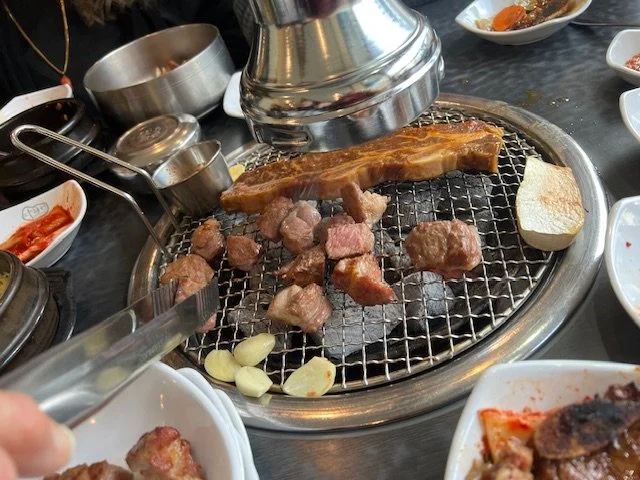
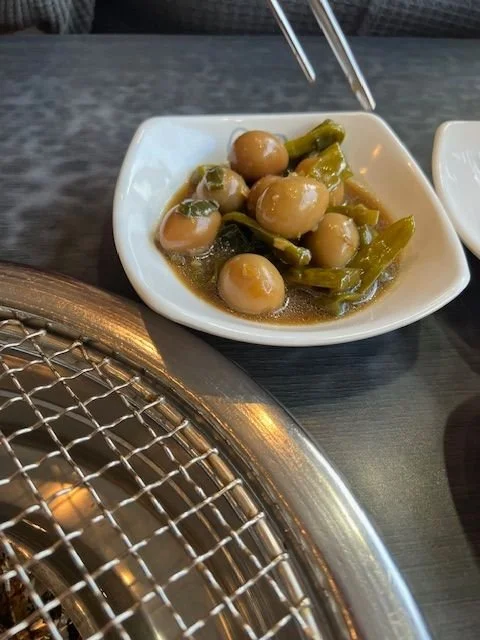
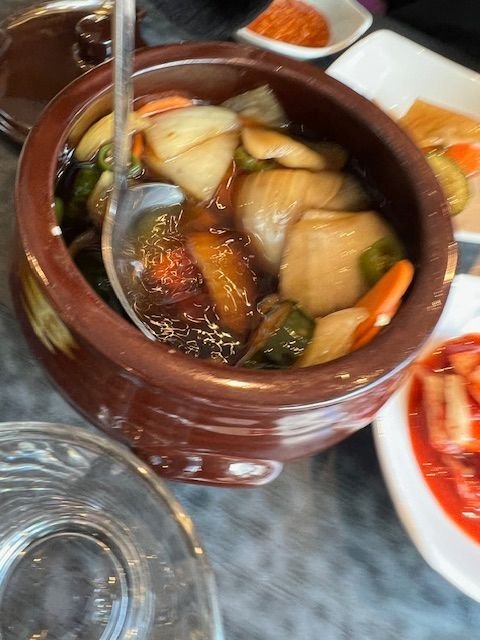
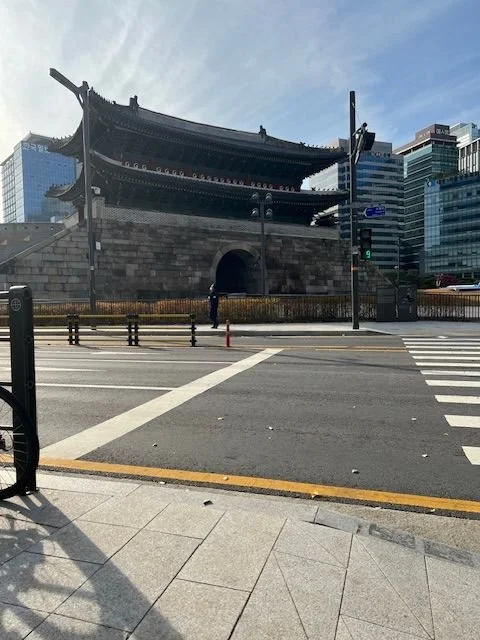
Unfortunately, I do not know the restaurant's name, but it was next to Namdaemun Gate, one of the Eight Gates around the city. King Taejo founded the Joseon Dynasty after overthrowing the Goryeo Dynasty in 918. He constructed a wall, Hanyang Doeong, to protect the newly established capital, and then built these gates between 1396 and 1398 to allow entry to the city. This gate was built in the last year of King Taejo’s reign in 1398.
This restaurant served various kinds of banchan, side dishes. I was happy to see one in particular, Dortori muk, the acorn jelly. I saw it several times in K-dramas and wanted to try it.
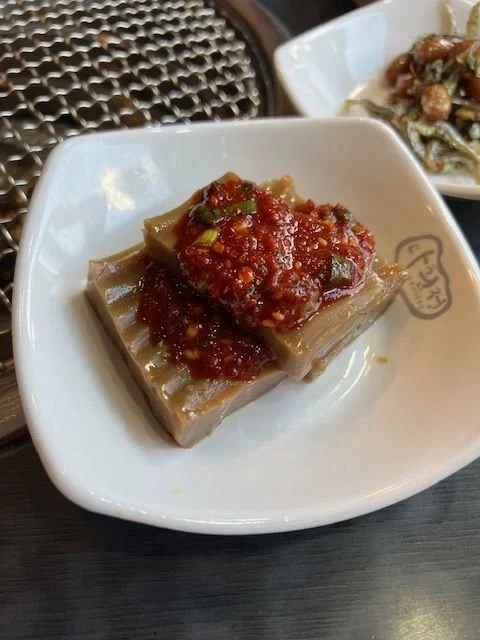
Born and raised in Arkansas, I grew up with oak trees and acorns. We played with them as children, but no one ever mentioned that you could eat them. I was a little surprised because growing up in a rural area of Arkansas, my Grandma Huff cooked most everything, including poke salad. Poke salad was made by very few people because it can be poisonous if made incorrectly.
After some research on acorns, I discovered that they were a major food source for North American Indians, especially in California, where they were plentiful. Three-fourths of California Indians, who were hunters and gatherers, used them as a primary food source. The acorns were gathered and turned into flour for bread.
Then I checked Europe. During the Middle Ages, acorns were eaten as emergency food when corn was scarce. Most of the time, acorns were animal feed, especially for pigs. However, in the 11th century, a terrible famine struck southern Italy, and many people stole acorns from pigs. They dried, ground, and mixed with millet flour.
However, acorns are still gathered for certain dishes in Korea, Japan, and China. In fact, a large commercial harvest of acorns still occurs in China, and acorn flour is sold on the streets, as well as in Japan and Korea.
Making the flour is time-consuming, and many steps are required to eliminate the tannins. I checked Amazon to see if they sold acorn flour (starch). Of course, they do.
Korea, Japan, and China all make Dortori muk. In Korea, Dotori muk was made in the mountainous areas of ancient Korea, where oak trees were plentiful. Just like the other parts of the world, it was a viable food source during food shortages.
During the 1592 Japanese invasion of Korea, King Seonjo fled to the north. Food was limited, and the villagers prepared it for him and his entourage. When he returned to his palace, King Seonjo continued to eat dortori muk in remembrance of the hardship of war. To this day, Koreans remember their past and enjoy the popularity of Dortori muk for its historical significance and its role of resilience and adaptability in the face of adversity.
I enjoyed the Dortori muk. It has a mild, earthy, nutty flavor. It was topped with a mixture of soy sauce, water, Korean red pepper chili powder, sesame oil, sesame seeds, sugar, and chopped green onions. https://www.maangchi.com/recipe/dotorimuk-muchim
Making your own acorn flour: https://honest-food.net/acorn-flour-recipe-cold-process/
Thank you again for reading my blog. Part three will be coming soon. It will include the Changdeokgung Palace and the famous Samgyetang soup, the Korean version of chicken soup. YUM YUM.